A Delegation from Switzerland and International Organisations Presented the ‘Competitiveness for Ukraine’s Recovery 2026–2030’ Programme in Vinnytsia
17 June 2026, 11:04
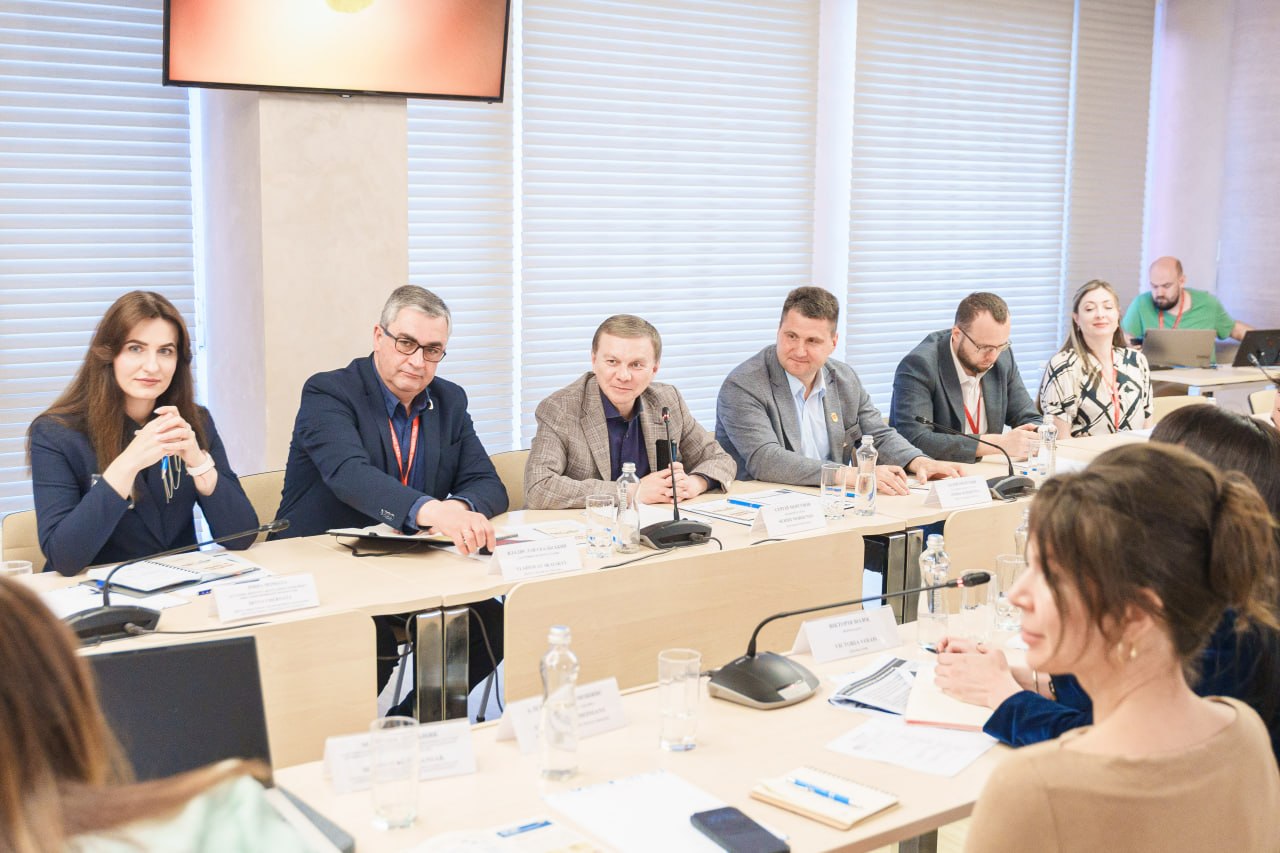
A team of international experts on reconstruction and economic development, representing the Swiss Embassy in Ukraine, SECO, Helvetas, the International Labour Organisation and the UNIDO Programme, is currently working in Vinnytsia. Together with Vinnytsia’s Mayor Serhii Morhunov, they discussed successful Vinnytsia-Swiss projects during a working meeting, as well as the opportunities offered by the new ‘Competitiveness for Ukraine’s Recovery 2026–2030’ programme and the next steps in cooperation with our community.
Vinnytsia Mayor Serhii Morhunov thanked the distinguished delegates for their interest in the Vinnytsia community and their support.
He explained that the city council team is systematically developing the economic sector and the community’s resilience. To alleviate the difficulties faced by entrepreneurs – such as security issues, staff shortages and power cuts – the community is implementing business support measures such as partial compensation for personal income tax on newly created jobs, loans, and the installation of renewable energy sources. The city is also assisting with the reconstruction of enterprises destroyed by russia.
At the same time, the development of industrial parks is continuing in the community – there are currently six registered in Vinnytsia, with a total area of over 135 hectares; some are under active development, whilst others already have tenants and operational production facilities. Another key element for economic development is the ‘Crystal’ Innovation and Technology Park, created to bring together entrepreneurs, scientists, IT specialists and creative young people.
‘Competitiveness and recovery are important issues for our community. We view them not only in terms of infrastructure reconstruction, but also from the perspective of the economy. After all, this is about jobs, taxes, the ability to support the army and maintain stable employment within the community. That is why we have always regarded business as a partner. We currently have over 55,000 businesses. Nearly 130,000 residents work in this sector. That is more than a third of the population,' said Serhii Morhunov. 'At the same time, we are keen to explore new opportunities and collaborate with all our partners to strengthen both our support for business and our ability to attract external assistance.'
When presenting the new project, the delegation from Swiss government and international agencies emphasised the importance of enhancing the competitiveness, resilience and modernisation of small and medium-sized enterprises, industries and regional economies, as well as supporting inclusive economic recovery and harmonisation with European standards.
As noted by Mariana Kahaniak, Technical Manager for Economic Recovery at Helvetas Ukraine, this programme is designed to run for five years, and the Swiss government has already confirmed its intention to extend it into a subsequent phase. The grant component of this initiative provides for dozens of projects for entrepreneurs in the region.
‘We see significant potential in the areas of sustainable construction, the processing industry and IT. The programme’s main instrument will be grants, which will be awarded on a competitive basis. These are not subsidies, but joint investments in ideas, time and resources aimed at development, growth and the implementation of innovations. Support will focus on labour market inclusivity, European integration, green and digital transformation, as well as the creation of added value. All projects must be linked to Ukraine’s recovery and contribute to long-term transformational change,' she noted.
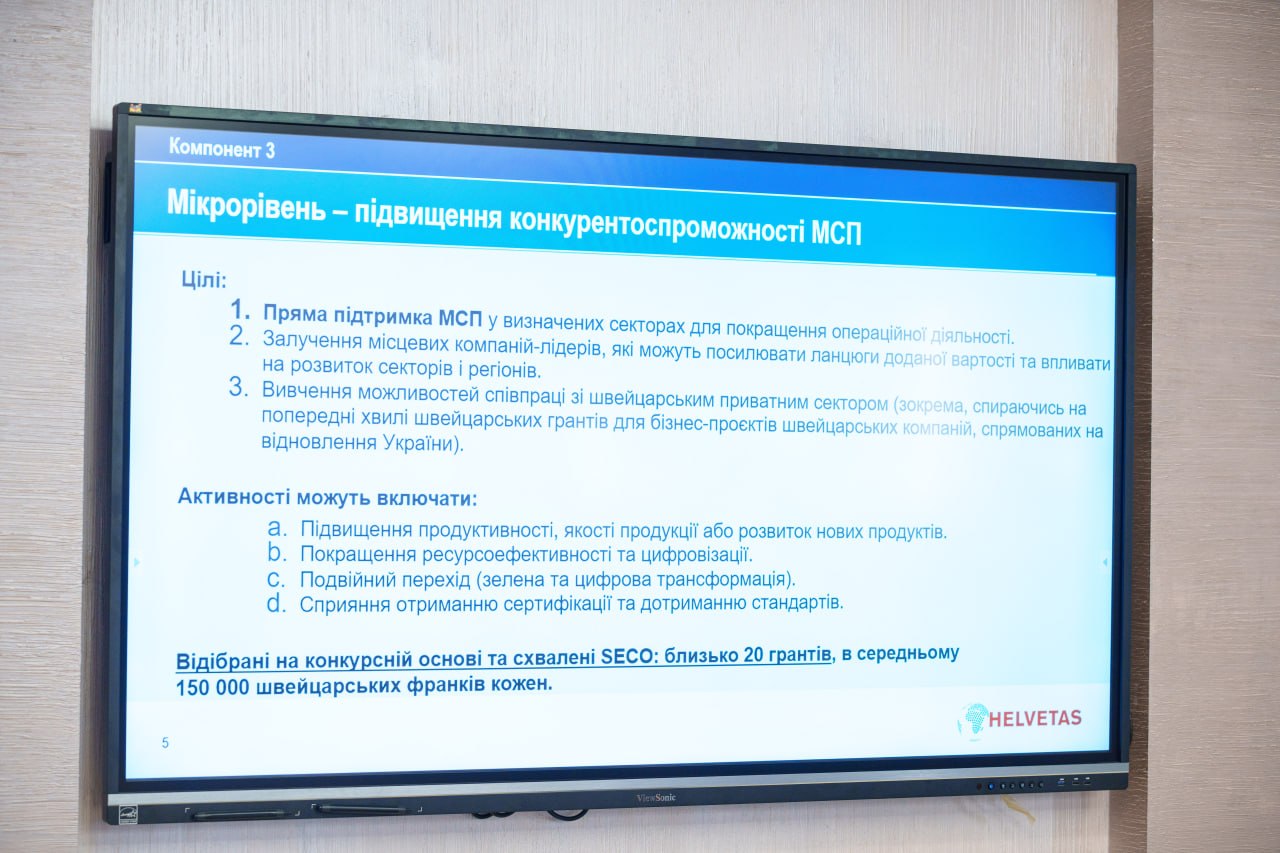
Overall, the ‘Competitiveness for Ukraine’s Recovery 2026–2030’ Programme consists of four interlinked components. The first component focuses on policy and the regulatory environment, the second on sectoral competitiveness and value added, the third component provides support for small and medium-sized enterprises to boost productivity, whilst the fourth, cross-cutting component of the initiative aims to expand the labour market by creating new opportunities for training and employment for women, young people, internally displaced persons and veterans, as well as adapting professional skills to the needs of the digital and green economy.
Gender equality, social inclusion, decent work, digitalisation and the green transition are key priorities of the Programme, noted David Marcos, head of Component 4 of the ‘Competitiveness for Ukraine’s Recovery 2026–2030’ project, who also represents the International Labour Organisation.
'An important area is the development of the labour market and the creation of decent employment conditions, in particular through grant schemes for employers. At this stage, we are focusing on production and processing, helping small and medium-sized enterprises to adopt European standards and improve their production processes and management. We also support staff training and the development of their professional skills,' said David Marcos.
The programme will provide competitive funding for projects run by institutions and small and medium-sized enterprises on a co-financing basis, as well as targeted expert support to address challenges that cannot be resolved through grant-based instruments alone. Funding will be disbursed in stages, in line with the achievement of defined results, enabling a flexible response to changes and allowing resources to be focused on the most effective solutions.
'We will continue to work on supporting and developing local businesses, strengthening their capacity to innovate, expanding export opportunities and creating added value. One of the tools will be grant programmes: 20 grants of 120,000 Swiss francs each are planned. These resources will help enterprises increase production, improve product quality and better prepare to operate in line with European Union standards,' said Stanislav Bazalieiev, Deputy Head of Components 2 and 3 and Regional Coordinator of the ‘Competitiveness for Ukraine’s Recovery 2026–2030’ programme.
Натисніть на зображення, щоб збільшити його
.jpg "A Delegation from Switzerland and International Organisations Presented the ‘Competitiveness for Ukraine’s Recovery 2026–2030’ Programme in Vinnytsia")
.jpg "A Delegation from Switzerland and International Organisations Presented the ‘Competitiveness for Ukraine’s Recovery 2026–2030’ Programme in Vinnytsia")
More news on topics
-
29 June 2026, 10:50
Vinnytsia City Council Presented Investment Projects at the URC 2026 Ukraine Recovery Conference
-
25 June 2026, 11:58
Vinnytsia’s Experience in the Field of Energy Sustainability Was Presented at a European Conference in Dijon
-
24 June 2026, 10:39
A Vehicle from Panevėžys Will Bolster the Teams at ‘Vinnytsiamisklift’
-
09 June 2026, 13:46
Promoting Sport and Sharing Expertise. Vinnytsia and the Vinnytsia Region Have Signed a Memorandum of Understanding on Cooperation in the Field of Physical Education with the Bourgogne-Franche-Comté Region
-
08 June 2026, 09:51
From Community Resilience to Global Solutions: Vinnytsia Takes Part in the Urban7 Summit in Nancy
-
01 June 2026, 11:04
Young People from Vinnytsia Took Part in an International Forum in Dijon, France
Related news
All news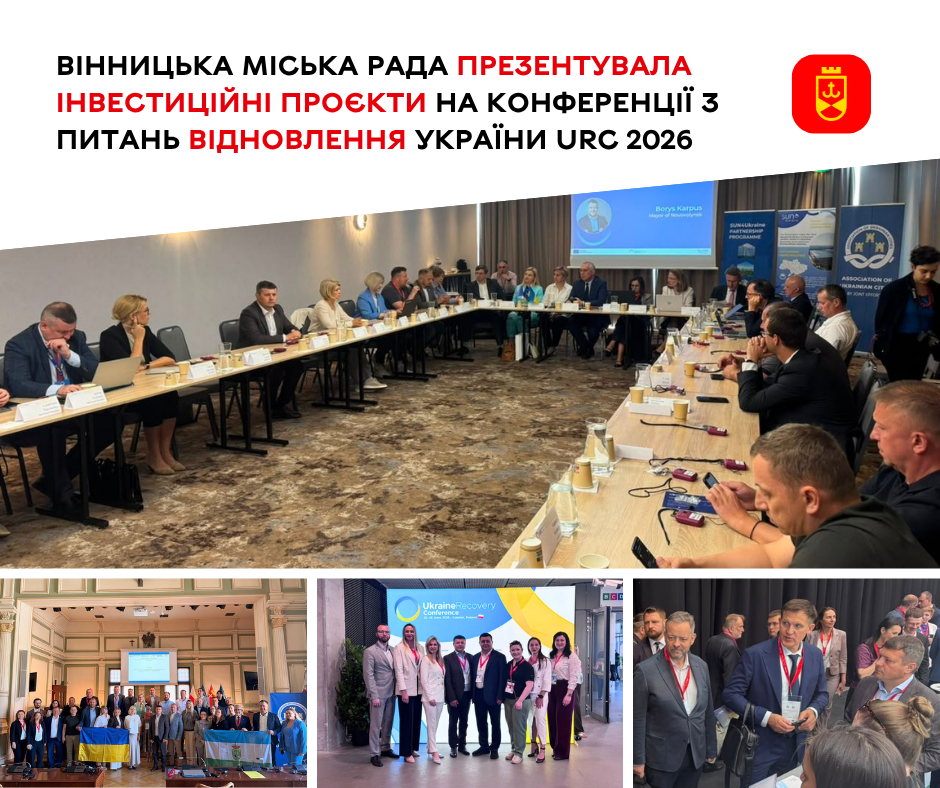
-
25 June 2026, 11:58
Vinnytsia’s Experience in the Field of Energy Sustainability Was Presented at a European Conference in Dijon
-
24 June 2026, 10:39
A Vehicle from Panevėžys Will Bolster the Teams at ‘Vinnytsiamisklift’
-
09 June 2026, 13:46
Promoting Sport and Sharing Expertise. Vinnytsia and the Vinnytsia Region Have Signed a Memorandum of Understanding on Cooperation in the Field of Physical Education with the Bourgogne-Franche-Comté Region
-
08 June 2026, 09:51
From Community Resilience to Global Solutions: Vinnytsia Takes Part in the Urban7 Summit in Nancy
-
01 June 2026, 11:04
Young People from Vinnytsia Took Part in an International Forum in Dijon, France
-
21 May 2026, 14:17
Discussions Were Held in Vinnytsia on Strengthening Cooperation with Switzerland in the Field of Water Supply with a View to Improving the Water Treatment System